

Cluj Innovation Days 2026: Between digital sovereignty and human adaptation
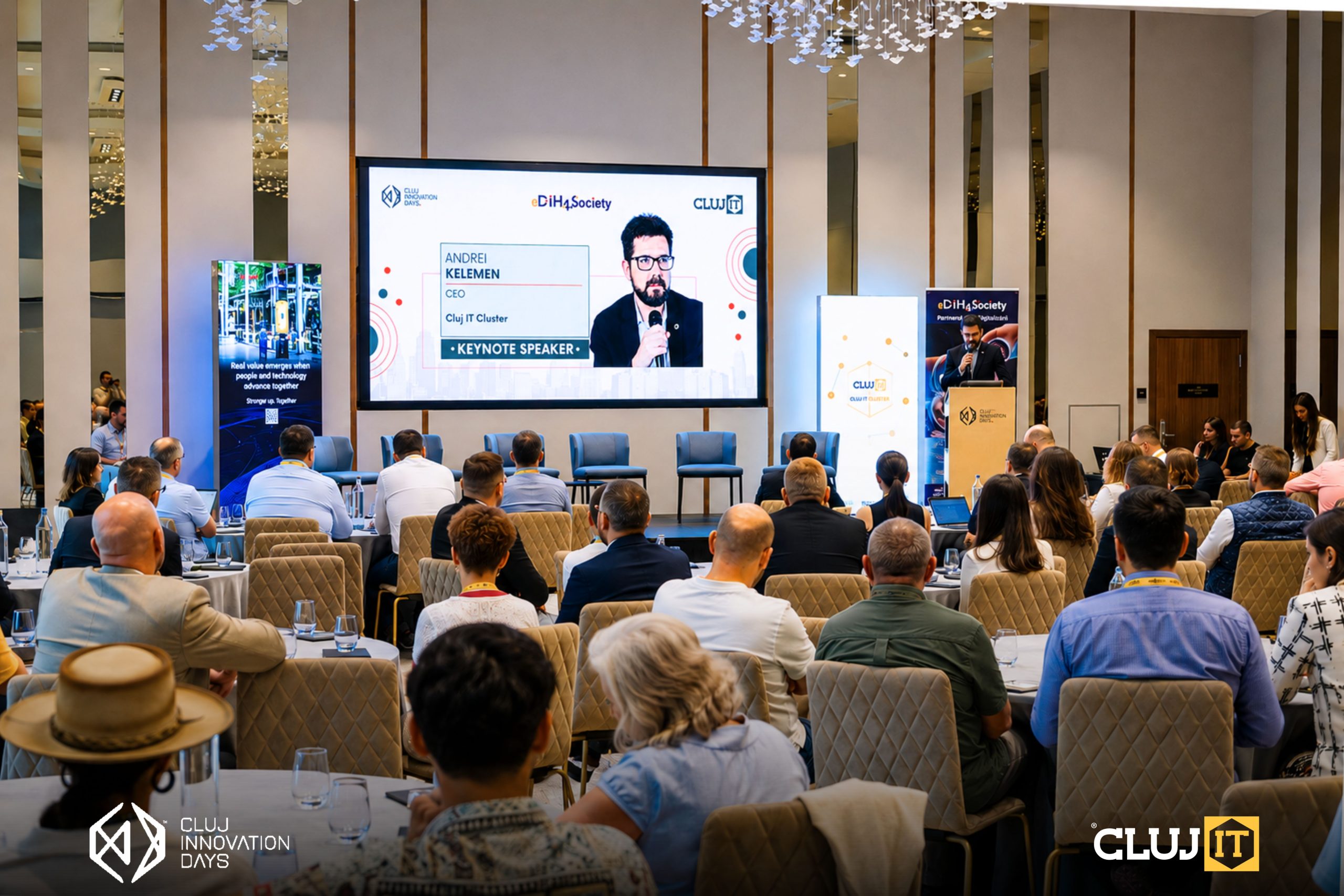
At the end of May, Cluj Innovation Days 2026 brought together in Cluj-Napoca Europe's technology elites, at a time when the transition to Artificial Intelligence (AI) has ceased to be a theoretical promise and become an urgent reality. This year's edition went beyond simple debates and functioned as a point of convergence for industry leaders, researchers and policy makers, while also marking concrete steps for Romania's digital ecosystem.
The event, organised by the Cluj IT cluster, as part of the Digital Innovation Hub 4 Society (eDIH4Society) initiative, highlighted key moments that will define the national technology landscape in the coming years.
A technological “Europe” through concrete partnerships
The conference began with announcements that change the architecture of innovation support in Romania. The Cluj IT cluster and the National Institute for Research and Development in Informatics (ICI) in Bucharest signed a strategic cooperation agreement. The importance of this partnership goes beyond the local sphere: the Bucharest institute manages the project AI Factory in Romania, an essential component of the European strategy. At continental level, the European Union is now funding a strategic network made up of 13 such structures AI Factory and 5 large-scale projects of the type AI GigaFactory, with Romania thus anchored directly in this technological sovereignty effort.
At the same time, the success of the eDIH4Society model led the European Commission to approve funding for stage 2.0 of the project, starting on 1 July. This new phase marks not only a continuation, but a major geographic expansion, bringing the expertise and services managed from Cluj to the South-West Region of the country as well.
Andrei Kelemen: Beyond technological prejudices
Opening the conference, Andrei Kelemen, CEO of Cluj IT, issued a call for realism: human society is facing transformations that are happening at an astonishing speed, for which we do not yet have a coherent answer. Kelemen illustrated the gap between perception and reality through a revealing experiment presented at the event: art critics rejected a painting (a fragment of a Renoir) as “soulless” or “worthless” as soon as they were told, deliberately falsely, that it had been generated by an algorithm.
For Andrei Kelemen, this case is clear proof of the deep prejudices that block our understanding of AI's real potential. “Cooperation formulas are essential for Europe to cope with the competition coming from North America and Asia,” he stressed, defining Cluj Innovation Days as a necessary platform to facilitate this convergence between the IT industry, entrepreneurs and scientific research.
Companies facing the mirror: Experimentation vs. Rigidity
If at strategic level the discourse is about cooperation, the reality on the ground for companies shows a very different picture. Denisa Cristache, the Accenture representative, presented a harsh X-ray of AI adoption in the private sector, based on her company's studies. The figures are a wake-up call: only 18% of companies currently manage to use Artificial Intelligence to generate real added value.
The main cause is not the lack of technology, but a cultural barrier. Only 17% of employees feel safe enough to experiment with AI and, more importantly, to accept failure as an integral part of the learning process. “The new paradigm of Artificial Intelligence implies a fundamental change: the transition from static jobs to a culture of continuous learning and experimentation,” explained Cristache. She stressed that the effectiveness of technologies is drastically limited by the fact that they often work “in silos”, without being interconnected, which blocks the scaling of innovation across the whole organisation.
This difficulty of companies adapting at micro level is reflected in a systemic problem at macro level. Antonio Grasso, director of public affairs at the European Digital SME Alliance, raised the concept of “digital sovereignty”, which remains, for the time being, a distant goal. Grosso pointed to the worrying figures of the European market: 70% of Europe's cloud market is controlled by American giants, and European Union investments in research and development represent only 7% of the global total.
For Grasso, this chronic underfunding and external technological dominance represent direct economic risks for Europe. “We are in a race against the clock. Without a concerted effort and massive investment, the European economy risks becoming a mere consumer of technology, without having control over the critical infrastructure on which the future will be built,” he warned during the debates in Cluj.
Education and the challenges of a new era: The vision on transformation through AI
The debate naturally moved to the educational pillar, an area deeply marked by the uncertainties of new technologies. The Rector of Babeș-Bolyai University and former Minister of Education, the psychologist Daniel David, addressed society's fears directly: the impact on mental health and the risk of job losses. It is natural, he noted, for the adoption of Artificial Intelligence to give rise to such fears. However, David offered a pragmatic perspective: although the risks are real and some have already materialised, they are not inevitable. “Nobody forces us to use Artificial Intelligence in a harmful manner,” he stressed, proposing instead a proactive and controlled approach.
A frequent concern in academia is the risk that AI may affect students' ability to memorise essential information. Faced with this risk, the UBB rector suggested that the solution is not to ban the technology, but to develop meta-educational strategies, through which students are guided to internalise the value of truth, beyond simply accessing raw information.
Professor David proposed a clear vision of integrating AI in education, structured in three distinct phases:
- The current phase, in which AI takes over the automation of repetitive and administrative tasks.
- The transition phase, where the technology becomes a “companion agent”, a support for teachers and students in the educational process.
- Faza viitoare, quite distant, of “virtual teachers” – these would be trained and strictly monitored by human teachers to provide support when human teachers are not available.
The same logic of controlled integration can be applied in psychology. To illustrate the beneficial potential of the technology, Prof. David offered an eloquent example: working with children with severe autism. Although they have major difficulties in learning social skills through direct interaction with other people, they have proved capable of acquiring these skills from robots. However, the UBB rector drew a red line: human control. No matter how advanced these systems become, perhaps reaching a point where they will be perceived as entities with rights and obligations, practically creating “two intelligent species” on the planet, it is vital to impose clear constraints and limitations. “We must make sure that we control Artificial Intelligence and not the other way around,” warned Daniel David.
A new phase for eDIH4Society: From hardware to digital transformation
One of the most ambitious projects in the field of digital transformation, the Digital Innovation Hub for Society (eDIH4Society), has demonstrated its viability in its first stage. The project provided digitalisation services for over 145 private companies and over 50 public institutions and hospitals in the North-West Region of the country.
Andrei Kelemen, general manager of the Cluj IT cluster, officially announced the start of the stage eDIH4Society 2.0, scheduled for 1 July. “We have signed the funding contract with the European Commission and we are in the process of securing national co-financing,” he specified. Kelemen stressed that, whereas in the first phase the services were offered free of charge through the subsidising of 50% of costs by the European Union and the other 50% through co-financing by the Romanian state, the new stage brings a strategic geographic expansion: the services will now also be available to companies and public institutions in the South-West Region, in addition to those in the North-West.
From the perspective of the managing authorities, this project marked a paradigm shift. Petrică Ciupitu-Istrate, director of monitoring at OIPSI, described eDIH4Society a genuine national success. “It contributed to the digital maturation of over 500 companies nationwide, but, more importantly, it forced a change of mindset in the public sector,” he explained. Ciupitu-Istrate noted that, after two decades in which the state funded almost exclusively the purchase of hardware and software equipment, this hub has shown that the real need is the transformation of processes and ways of working.
This paradigm shift was also felt in the private sector. Edgar Zoltan, the project manager, added that the success lay precisely in the fact that the approach was totally different from classic European projects, emphasising the delivery of immediate value to beneficiaries, not just compliance with rigid bureaucracy.
The future that has already begun today
One of the most thought-provoking debates at Cluj Innovation Days 2026 was dedicated to the relationship between emerging technologies, artificial intelligence and future generations. The discussion explored how innovation is transforming society and the labour market, the conclusion being that progress does not depend only on the performance of algorithms, but on the people who develop and direct them.
Bogdan Teodorescu, a master's student in astronomy at the University of Vienna (with a UBB bachelor's degree), opened the series of young perspectives, pointing out the critical importance of scientific communication. “Meaning is what matters now, much more than collecting data or the calculations themselves,” he said. In an era in which AI calculates quickly, human value lies in the ability to interpret, contextualise and give meaning to results. Teodorescu also pointed to a systemic gap: students are overwhelmed by administrative and academic tasks, and skills such as presenting to diverse audiences or decision-making under uncertainty are not yet explicitly integrated into the curriculum.
From the industry's perspective, Gergő Tóth-Batizán (Accenture Romania) contradicted fears about job disappearance, anticipating instead an evolution of jobs towards “systemic thinking”. Companies are now looking for employees who can navigate between the technical and operational worlds. “We are not looking for single technical experts, but for people who understand systems and can collaborate in a hybrid human-AI environment,” he explained, stressing the importance of workshops in which students solve real problems from real clients.
Professor Radu Silaghi-Dumitrescu (UBB) completed the picture with an analysis of the cultural distance between generations. He warned about the danger of “cliché communicators” – those who use terms such as “revolutionary” for modest innovations. The mission of the university remains the same: to teach students to savour knowledge and exercise critical judgement, especially in a context in which exponential digital tools can create the illusion of competence.
This need for “reality” was also supported by Răzvan Bretoiu (Linify), who proposed a “radical integration” approach for researchers. “Before any technical integration, I want researchers to be present at client meetings. To see the real problem,” he noted. The mindset must be one of being close to the user, avoiding isolation in laboratories.
At the end of this section, Sofia Tsekeridou (an expert with 25 years of experience in EU projects) highlighted the importance of mentoring for young researchers. Although European projects offer immense cross-border collaboration opportunities, they require complex negotiation and presentation skills in multicultural consortia. “When young people see experienced researchers showing them how they commercialised their results or how they navigated a European project, they become more motivated to follow the same path,” concluded Tsekeridou.
The “AI and the Future of Work” panel: Between autopilot and human control
One of the central sessions of the conference was the panel entitled “AI and the Future of Work: Skills, Jobs and Transformation”, moderated by Konstantinos Georgiou, project manager at SKILLAB. Experts with diverse perspectives from Ireland, Spain, Belgium and Romania took the stage, offering a complex X-ray of a change that can no longer be postponed.
The pilot must know how to pilot
Ernestina Menasalvas, professor at the Department of Computer Science of the Polytechnic University of Madrid, opened the debate with a suggestive analogy: an aeroplane can fly on autopilot, but when turbulence appears, the pilot must be able to take control. “You can rely on AI, but only if you know what you are asking of it, if you understand the knowledge behind it and, above all, if you are the one who makes the final decision,” noted Menasalvas.
She issued a firm warning to university systems: the classic model, based on a single final exam, is already outdated. In a world in which the technologies taught today risk becoming useless by the student's first promotion, the role of the university is no longer just to provide technical knowledge, but to cultivate critical thinking. Menasalvas raised an issue that many teachers avoid: if we do not change the way we assess, we will continue to produce students who “copy and paste” best, instead of forming people who know how to decide.
Industry wants people who judge, not people who execute
Dave Feenan, general manager of Digital Technology Skills in Ireland, brought up a successful national model, built on strict collaboration between the state, industry and universities. In Ireland, companies' payroll taxes are collected and reinvested exclusively in vocational training programmes. “When we created the AI courses, we did not start from theory, but asked the industry: what real skills do you expect?” explained Feenan.
This model created a bridge between academic delivery and the labour market, giving Ireland a competitive advantage. However, Feenan drew attention to the fact that the current transformation is different from past industrial revolutions; it does not only affect factories, it hits at all levels. The most optimistic aspect he pointed out was AI's capacity to democratise entrepreneurship: “For the first time, AI provides conditions for ordinary people to stop applying for jobs and create them instead. A micro-enterprise with two or three people and a few software agents can become a viable market player, and Europe must support this model through adapted policies”.
Loredana Bucșeneanu (ARISA, Digital SME Alliance), who coordinates a European Union-funded initiative that brings together over 70 organisations from 23 countries, offered one of the most lucid diagnoses of the session. “We do not have a motivation problem. We have a system that is flawed by design,” she noted. Bucșeneanu explained that, although both employees and companies – especially SMEs – are aware that AI will transform their activity, participation in reskilling programmes remains low because of three major structural barriers:
- Timpul: In an SME, an hour spent in training is an hour in which no immediate revenue is generated, the cost being visible, while the benefits are hard to quantify in the short term.
- Rigiditatea ofertei: Current courses are often too static and academic, failing to meet the urgent practical needs of an entrepreneur.
- The trust gap: Many employees, especially those in middle management, exclude themselves from the learning process, believing that AI is only about “code and advanced mathematics” and that it is not addressed to them.
“The responsibility for reskilling cannot rest on the shoulders of the individual. Governments, industry and alliances like ours must build this infrastructure together,” concluded Bucșeneanu.
Legal risks and corporate responsibility
Flavius Florea (Wolf Theiss) brought the discussion into the area of legal pragmatism, warning about the concrete risks that can affect companies right now. He mentioned Article 22 of the GDPR, which protects employees against decisions taken exclusively by automated systems in processes such as hiring or performance monitoring, without human intervention. Florea also drew attention to algorithmic discrimination – AI being able to amplify the biases existing in data – which classifies HR systems as “high risk” under the AI Act.
Another critical point touched upon was intellectual property. “If a company develops code entirely through AI, without significant human involvement, that code will not be owned by that company. The mere act of writing a prompt does not confer copyright,” stressed Florea. His prediction for 2030, however, is optimistic: European companies that invest now in compliance and governance will become the preferred partners of global players.
The role of the State: between regulation and encouragement
Viorel Băltărețu, entrepreneur and former secretary of state, used a historical analogy to illustrate the risk of excessive regulation: the British law that obliged a person to walk in front of cars with a flag and a whistle to warn pedestrians. “I wonder whether we are not doing the same thing now with AI: we are not protecting citizens, we are slowing down the future,” he said.
Băltărețu defined three essential roles for the state in this context:
- Clear communication: Concretely explaining the benefits of AI to citizens, entrepreneurs and employees.
- Stimulente financiare: Creating real levers for technology adoption and workforce training.
- The demonstration model: The public sector must become a testing platform; when citizens see government services simplified through AI, the technology becomes legitimate in their eyes.
Băltărețu concluded that Romania's position, currently last in the European Union in AI adoption, is not a source of shame, but an enormous opportunity. “We must work together with people, not around them,” he added, stressing that success depends on the ability to include society in this change process.
Innovation from the laboratory: The lesson of Cristian Presură
Beyond European policies and strategies, innovation remains a deeply human act. Journalist Florin Zubașcu brought before the audience a revealing discussion with the physicist Cristian Presură about how an idea can travel the path from a Friday afternoon experiment to a technology adopted by tens of millions of people.
Presură, a researcher at Philips Research Eindhoven, debunked the myth of planned invention, giving the example of the optical heart rate sensor in smartwatches. “You cannot plan an invention. We were measuring the speed of blood in arteries and I saw that I had a good cardiac signal. I said to myself: I'll put it in a watch,” the physicist recounted. At that time, the technology was considered a “gadget” for athletes, but his intuition laid the foundations for the sensors that today equip almost all wearable devices in the world.
This story served as the basis for an analysis of innovation culture. Philips Research functioned in its heyday as a true European Silicon Valley, offering researchers “intellectual freedom and time for crazy ideas”. Presură warned, however, about the erosion of this culture, noting with concern that, in recent interviews, candidates show increasingly poor fundamental technical knowledge. “Engineers who knew how to do things were the foundation. As people knew less and less, I saw how the essence was lost,” he noted.
As for Artificial Intelligence, the physicist admitted that he went through a stage of existential fear, which he overcame only through rigorous study, from Python courses to the analysis of technical models. “If you understand how AI thinks, you are above it,” he concluded, offering a lesson in technological realism: no matter how advanced the software, hardware will always remain the backbone of any innovation.
The urgency of a new paradigm
Cluj Innovation Days 2026 demonstrated, beyond any doubt, that the skills of the AI era are neither purely technical nor purely human, but lie at their intersection. The experts present highlighted that the development of talent and innovation can no longer depend on isolated efforts, but on an authentic and constant dialogue between different generations, fields and cultures.
A tangible proof of this need for cohesion was marked during the conference itself by the signing of the strategic partnership agreement between Cluj IT and the National Institute for Research and Development in Informatics (ICI) Bucharest. This initiative, which anchors local efforts in the national project AI Factory and aligns Romania with the European technological sovereignty effort, represents exactly the type of collaboration needed to turn vision into reality.
The conference ended on a note of urgency. The European Union has talent, resources and remarkable legislative capacity, but lacks a corresponding speed of adaptation. The final conclusion of the event is that the success of Romania and Europe in this global race ultimately depends on the ability to connect these elements — talent, education and entrepreneurial courage — in an integrated system, before the technological gap becomes impossible to recover.