

Cluj-Napoca, 2 iunie 2026
Cluj-Napoca consolidates its status as a major regional pole of technology, research and innovative entrepreneurship in Central and Eastern Europe. On 28–29 May 2026, the 14th edition of the international forum Cluj Innovation Days, organised by the Cluj IT cluster, brought together at the Radisson Blu Hotel Cluj hundreds of industry leaders, researchers, academics and public administration representatives to analyse the challenges of the labour market and ethical solutions in the era of Artificial Intelligence (AI). The event was attended by 250 people over the two days.
A strategic step for technological sovereignty: Partnership between Cluj IT and ICI Bucharest
During the event, a historic cooperation agreement was signed between two of the most important IT entities in Romania: Clusterul Cluj IT and the National Institute for Research and Development in Informatics (ICI Bucharest). The purpose of this partnership is to accelerate the adoption of technologies related to the evolution of AI. ICI Bucharest is the national coordinator of the project AI Factory in Romania, part of an elite European network.
“Cooperation formulas between relevant actors are essential for Europe to cope with global competition from North America and Asia,” stressed Andrei Kelemen, CEO of Cluj IT Cluster. Together with the general director of ICI Bucharest, Adrian-Victor Vevera, he pointed to the importance of connecting government research with the dynamism of the private and academic environment.
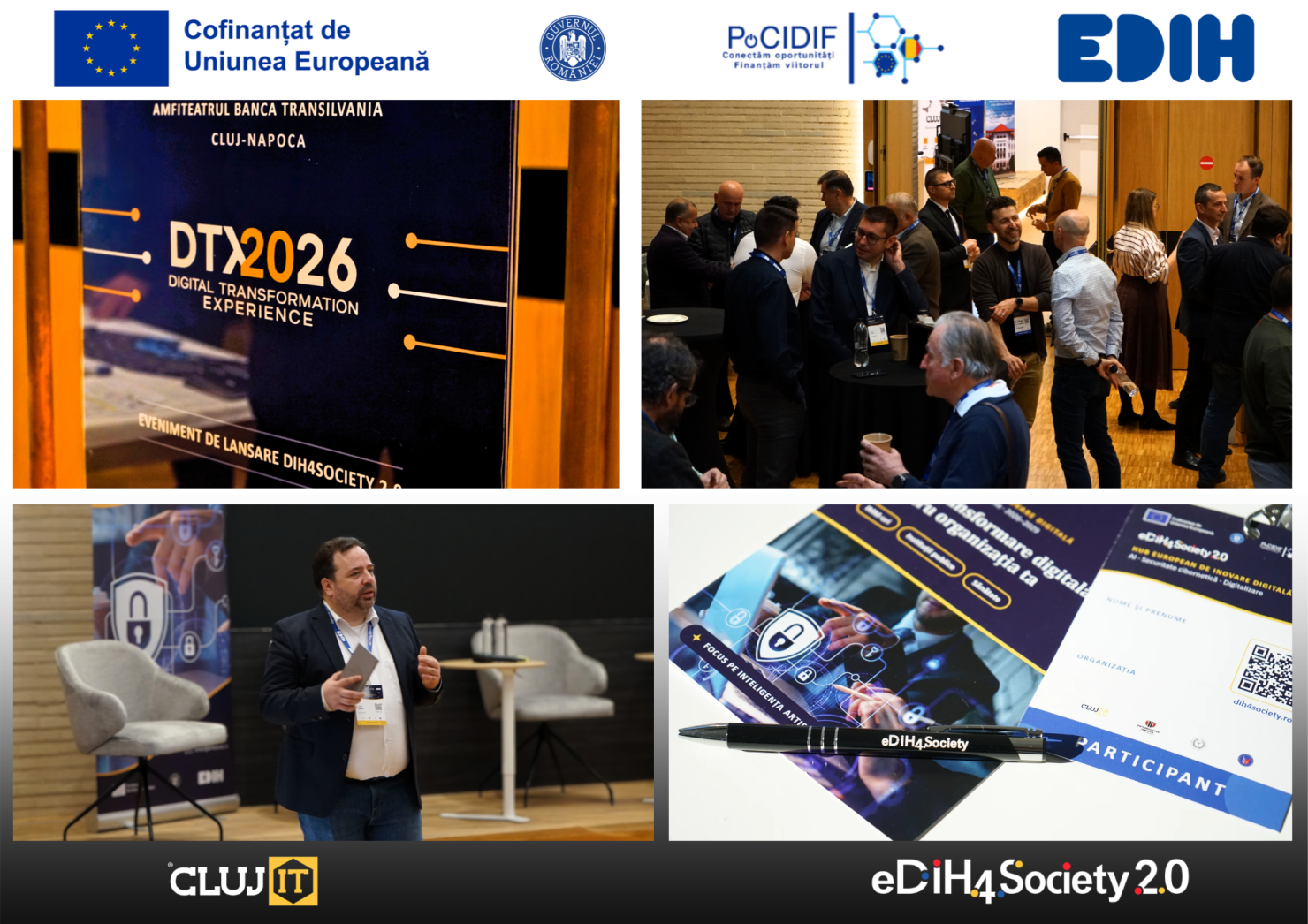
Success record for eDIH4Society and the launch of version 2.0
One of the central pillars of digital transformation discussed on the first day of the conference was the project eDIH4Society (Digital Innovation Hub for Society), officially recognised by the European Commission as a digital innovation node. At the end of its first three-year phase, the project reports a major impact on the economy: over 145 private companies (SMEs) and over 50 public institutions and hospitals from the North-West Region benefited from free services (technology testing before investment, skills training, funding support).
Moreover, Andrei Kelemen announced that, from 1 iulie 2026, va demara proiectul eDIH4Society 2.0, the funding contract having already been signed with the European Commission. This new stage will bring a major geographic expansion, with the hub offering digital transformation services also to organisations in the South-West Region of Romania.
For his part, Petrică Ciupitu-Istrate (director of monitoring at OIPSI) stated that eDIH4Society represents a real national success, contributing to a profound paradigm shift: moving from the simple purchase of hardware and software to the development of digital maturity and advanced skills (DeepTech, AI, cybersecurity).
Preparing for the future of work and the new “social contract”
The conference brought attention to worrying analyses, but also to concrete adaptation solutions. Denisa Cristache (Accenture) highlighted that, according to market studies, only 18% of companies use Artificial Intelligence to produce real value and only 17% of employees feel safe experimenting with new technologies. Similarly, Antonio Grosso (European Digital SME Alliance) warned that the European Union must increase its investments in research and development, given that the European cloud market is 70% dominated by American giants.
The president of Cluj IT Cluster, Prof. Stelian Brad, noted that the challenge of the present is not technology itself, but the transformation of “our cognitive architecture” in order to recalibrate how we learn and work.
A balanced vision was also offered by the rector of Babeș-Bolyai University, the psychologist Daniel David, who spoke about a new “social contract” of the AI era. He described the stages through which AI can become a positive educational and psychological tool — from the automation of repetitive tasks, to use as a companion agent for teachers and students and even as a therapeutic method (for example, in supporting children with severe autism). “It is essential to introduce clear limitations and constraints through which we ensure that we control Artificial Intelligence and not the other way around”, a explicat rectorul UBB.
Applied innovation and international hackathons
In addition to the strategic debates, Cluj Innovation Days 2026 included the practical component Skillab Testathon and Innovation Challenge, an international hackathon in which young innovators used real datasets to propose AI-based solutions for reducing the skills gap in the labour market. The projects were assessed by an international jury from Greece, Germany, Denmark and Romania, offering a launch pad for deeptech-type startups.
The final message of this year's edition remains firm: the future belongs to communities that learn continuously, and the response to the expansion of Artificial Intelligence must be accelerated investment in reskilling, ethical adaptation and close regional cooperation.
Despre Cluj IT Cluster:
Founded in 2012, Cluj IT is an innovative cluster association that brings together over 85 entities (software companies, universities, research institutes and public authorities) based on the Triple Helix model.
Despre eDIH4Society:
The European Digital Innovation Hub for Society (eDIH4Society) is a regional centre of excellence funded through the European Commission's “Digital Europe” programme and co-financed by the Romanian state, dedicated to supporting SMEs and public administration in adopting advanced technologies.
Website: www.clujit.ro, www.dih4society.ro, www.clujinnovationdays.ro