


Responsible DIH4Society partner
Technical University of Cluj-Napoca
Region covered
North-West
Facilities provided by the Distributed Laboratory for Industrial Robotics and Industry 4.0 Systems.
Specialised services:
- Exploring and verifying the use of industrial robots – We offer you support to design and test practical robotic applications where robots from renowned brands, such as ABB, Kuka, Fanuc, Motoman etc., are made available. The aim is to identify and implement solutions that optimise production processes.
- Implementing automation in production processes and increasing their efficiency – We focus on using advanced technologies to automate manufacturing processes, so as to achieve added efficiency and productivity.
- Analysing and supervising the performance of robotic solutions in the context of investment decisions – This service offers a thorough assessment of the viability and efficiency of robotic solutions before committing considerable funds to their implementation.
- Creating and testing artificial intelligence-based prototypes to improve industrial processes – Through this service, we undertake to develop and test prototypes of software applications that incorporate artificial intelligence for optimising industrial production.
- Monitoring equipment performance through I-IoT technology in smart manufacturing processes – We help you develop and test Industrial Internet of Things (I-IoT) technology to monitor equipment performance in real time and to adjust manufacturing processes efficiently.
- Analysing the financial and operational advantages of investments in Industry 4.0 and artificial intelligence – We offer detailed assessments that highlight the benefits brought by investments in Industry 4.0 and artificial intelligence technologies, to support informed decision-making.
- Improving skills in essential areas of Industry 4.0 – We provide training and skills development opportunities in a variety of key areas of Industry 4.0, including robot programming, artificial intelligence, industrial network security, digital simulations of production processes (digital twin), use of I-IoT and operations with autonomous mobile robots.
Access to advanced infrastructure for innovation in Industry 4.0:
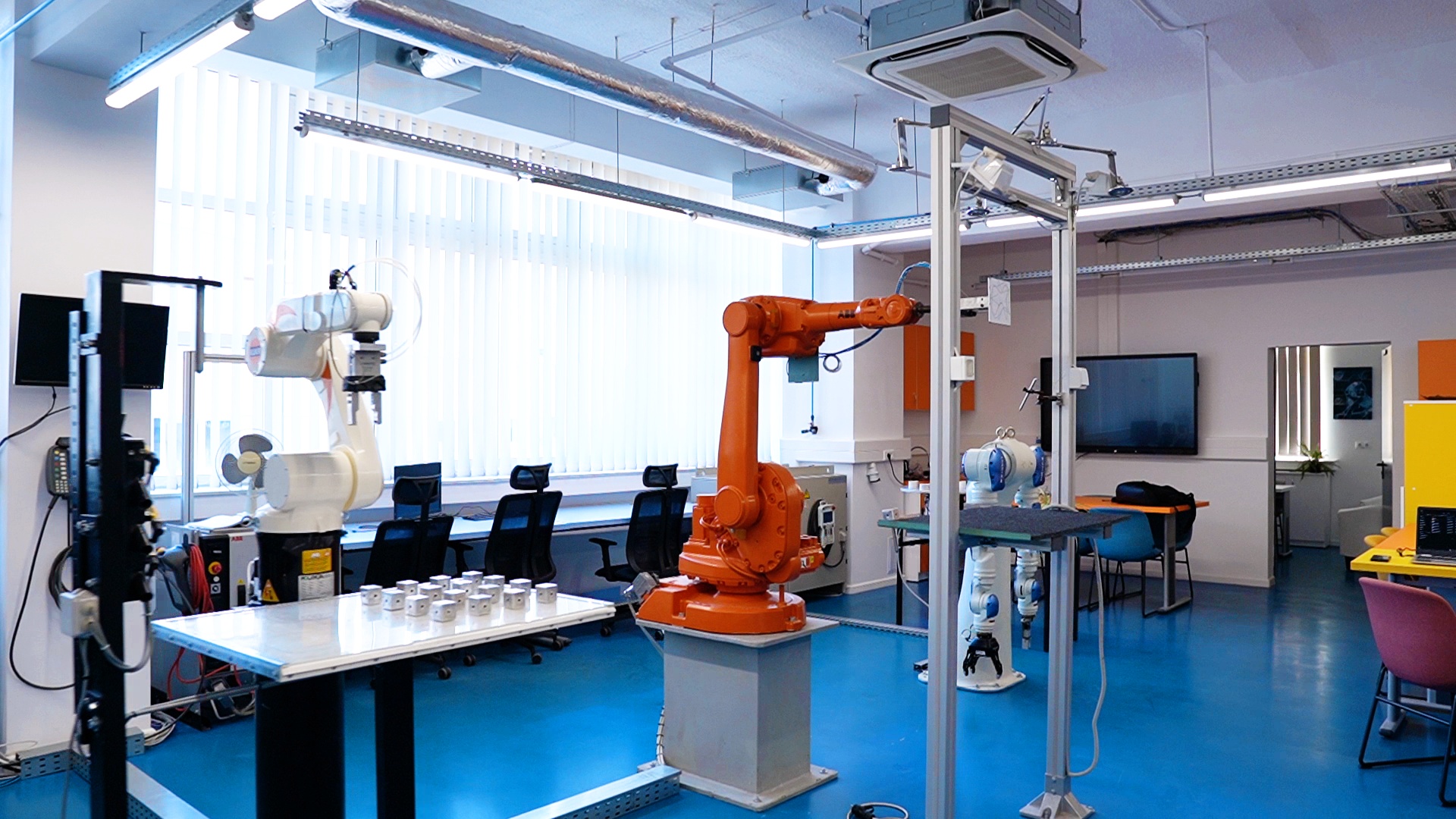
- Workstation with ABB IRB 1600 Robotic Cell – On this station, activities of automated handling and video inspection, integration of artificial intelligence for human-robot interaction, development and testing of applications with ABB robotic technologies, implementation of cloud communication solutions, programming in the RAPID language, development of client-server and edge computing applications, establishing communication between robot, PLC and computer, as well as experimenting with IoT applications can be carried out.
- Workstation with ABB IRB 1600 Robotic Cell for Electric Arc Welding – This station allows automated electric arc welding activities to be carried out, using the ABB IRB 1600 robotic cell. Applications with ABB robotic technologies can also be developed and tested, cloud communication solutions implemented, programming in the RAPID language, development of client-server and edge computing applications, as well as exploration of IoT applications.
- Workstation with ABB IRB 140 Robotic Cell for Assembly – This station is specialised in automated assembly activities using the ABB IRB 140 robotic cell. Applications with complex logic for handling, assembly, contouring, interaction between robot and PLC, as well as programming in the RAPID language can be carried out.
- Workstation with FANUC LR Mate 200 iD Robotic Cell – This station is intended for programming and using Fanuc robotic technologies, with applications that include operation of external axes, inspection and assembly.
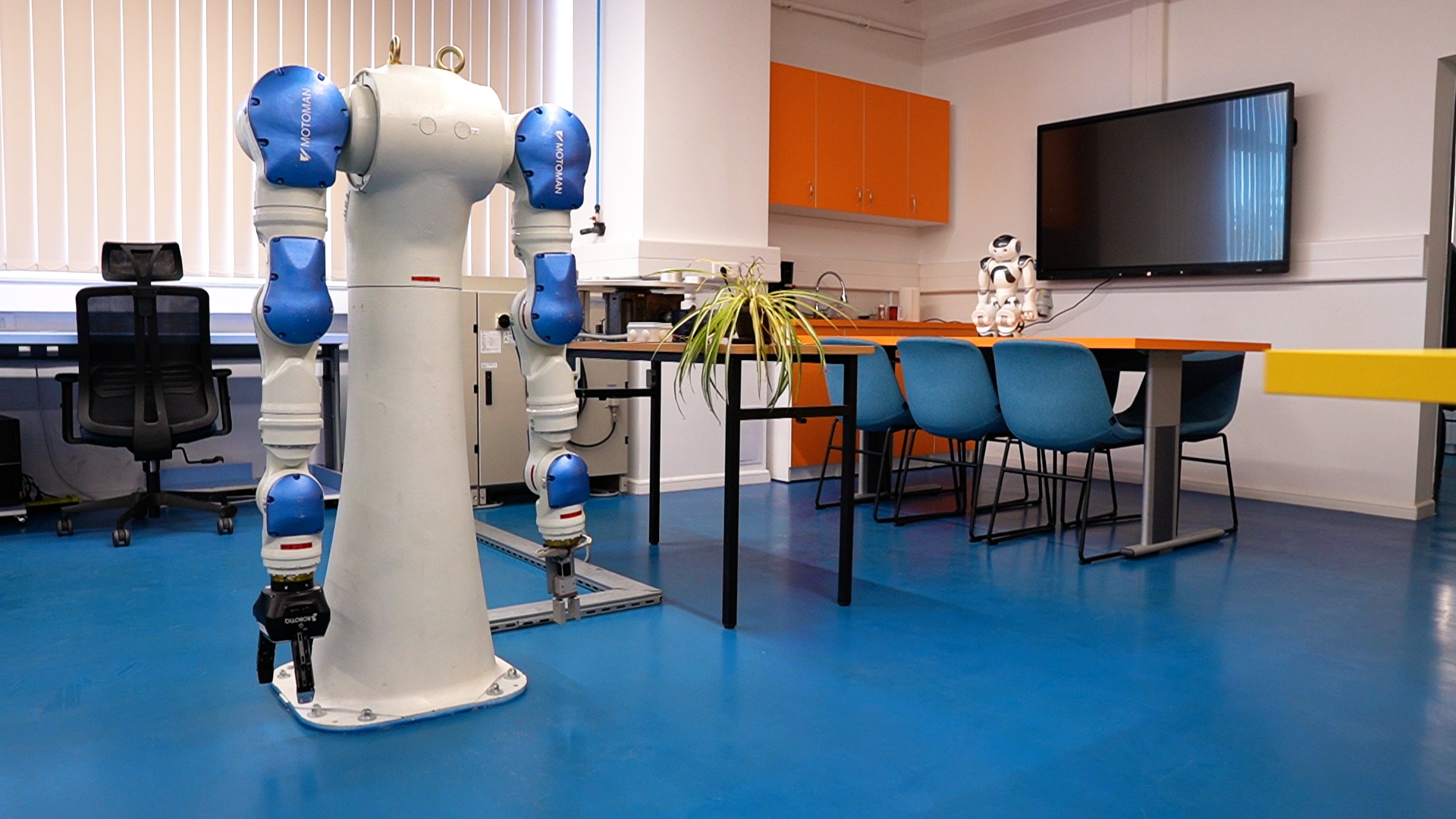
- Workstation with Motoman Yaskawa SDA10D Robotic Cell for Handling – This station allows complex assembly and handling activities to be carried out, using the Motoman Yaskawa SDA10D robotic cell.
- Workstation with Motoman Yaskawa SDA10D Robotic Cell with 2 Arms – This workstation offers the possibility of carrying out advanced handling applications, using the two-arm Motoman Yaskawa SDA10D robotic cell. Functionalities include TCP-IP communication with the ROBOTIQ gripper, I/O control of the SMC gripper, and I/O control of the indexing table.
- Workstation with NAO Humanoid Robot – At this station, companies can experiment with the social applications offered by the NAO humanoid robot. NAO is specially designed to interact with people in a natural and friendly way, which makes it ideal for customer service, education and research environments. Using sophisticated artificial intelligence algorithms, NAO can be configured to function as an interactive chatbot, offering personalised answers and conversing fluently with users. Through this service, companies can explore the potential of a robotic assistant in improving the customer experience and optimising internal processes.
- Workstation with Pepper Humanoid Robot – This station makes available the Pepper humanoid robot, which is specially designed for social interaction. Pepper is a robot with a unique personality, capable of recognising emotions, which makes it ideal for customer service environments and public events. Pepper can also be programmed to function as a chatbot, allowing it to hold complex conversations and answer questions in real time. Using this service, companies have the opportunity to explore the use of a humanoid robot to improve customer interactions and experience.
- Workstation with RobotStudio Software License for ABB Industrial Robots – This station allows the design and testing of complex robotic cells with ABB robots through the simulation and offline programming software RobotStudio. With a full licence, users can carry out virtual commissioning, develop human-robot interfaces, create client-server applications and cloud applications. This is an excellent opportunity for companies to experiment with and improve their automation processes using ABB industrial robots.
- Workstation with RoboDK Software License for Industrial Robots – At this station, using the RoboDK software licence, users can design and test complex robotic cells with any type of industrial robots. The service includes virtual commissioning, development of human-robot interfaces, creation of client-server applications and cloud applications. This offers companies maximum flexibility in experimenting with various types of industrial robots and in optimising their automation processes.
- Workstation with Visual Components Software License for 3D Simulation in Manufacturing – This station includes a licence for the Visual Components 3D simulation software, which allows the design and testing of complex robotic cells with any type of robots. Virtual commissioning, development of human-robot interfaces, creation of client-server applications and cloud applications are just some of the possibilities available. This is a valuable opportunity for companies that want to visualise and improve their production processes in a complex and accurate 3D environment.
- Workstation with Furhat Social Robot – Furhat is a unique interactive social robot that enriches interaction with users through its advanced humanoid expressiveness and its ability to interpret and respond to human interactions. At this station, companies have the opportunity to explore and develop applications for Furhat, including, but not limited to, customer support roles, educational support, or an interface for services and products. It is an opportunity to discover the potential and benefits that a social robot can bring to the business or educational environment.
- Workstation with Cybersecurity Module for Industrial Networks – This station is equipped with an advanced cybersecurity module for industrial networks, which offers an extensive range of functionalities for protecting and optimising production networks. The module includes functions for switching between industrial networks, monitoring, address allocation, routing, firewall, configuration of separate VLAN-type networks, network address translation (NAT), and setting up virtual private networks (VPN). In addition, the module is equipped with at least 30 ports to suit the varied needs of your industrial network. This service gives companies the possibility to test and optimise the cybersecurity of their industrial networks, thus protecting themselves against digital threats and ensuring that their production systems operate efficiently and safely.
- Workstation with Control Module for Open Systems – This station is equipped with an advanced control module for open systems, which can be used to optimise and customise the operation of industrial robots and robotic applications. The module includes five main components: Controler logic programabil: compatible with industrial robot axis control and for open robotic applications. It supports cloud communication, expansion of the number of inputs and outputs, and supports industrial communication protocols. It also includes a 24V/8A power supply, memory card, Ethernet cable, mounting rail. Human-machine interface: a large 15.6-inch screen with 16 million colours, which ensures efficient and intuitive interaction between operators and machines. The interface is compatible with the programmable logic controller. Software licences for industrial automation: a package of licences that enable the creation of industrial automation applications with programmable logic controllers, including cloud communication, gateway and simulation. Software licences and microcontrollers for industrial automation: a package of licences and microcontrollers that enable the creation of industrial automation applications, compatible with Windows, Linux and Mac OS. Power supply: a robust JXNC-YPS02-E power supply to ensure stable power for the entire system. Companies that use this service can test and develop control solutions for their open production systems, benefiting from a flexible and powerful environment that can be customised according to their specific needs.
- Workstation with Open Mobile Robotic Platform – This workstation includes an advanced and fully customisable mobile robotic platform, equipped with a ROS 1 or ROS 2 operating system and integrable with Gazebo. The platform is equipped with artificial intelligence functionalities and has 4 wheels, SLAM and V-SLAM systems for mapping and autonomous navigation. Through the obstacle detection system, LIDAR and stereo camera, this platform can be used in complex environments, offering advanced mobility solutions. It also includes a voice module for intelligent interactions and is equipped with an industrial PC, a control application and a monitor for efficient management. Using this workstation, companies can explore and develop innovative autonomous mobility solutions, applications for artificial intelligence and can experiment with advanced navigation and obstacle detection technologies.
- SIDEMO S7-315F Workstation + SMC Axis – This station offers the possibility to experiment with PLC programming and to control an SMC axis through the I/O architecture. It is an ideal environment for testing and improving industrial automation processes.
- V20 Demonstration Station – This workstation is specialised in parameterisation and control of three-phase motors, as well as Modbus RS-485 communication. It is a perfect space to learn and become familiar with the operation and control of electric motors and industrial communication.
- LOGO Soft Comfort Demonstration Station – This station allows PLC programming using the FBD (Function Block Diagram) programming language, as well as control of inputs and outputs (I/O). It is an ideal environment for those interested in PLC programming and industrial process control.
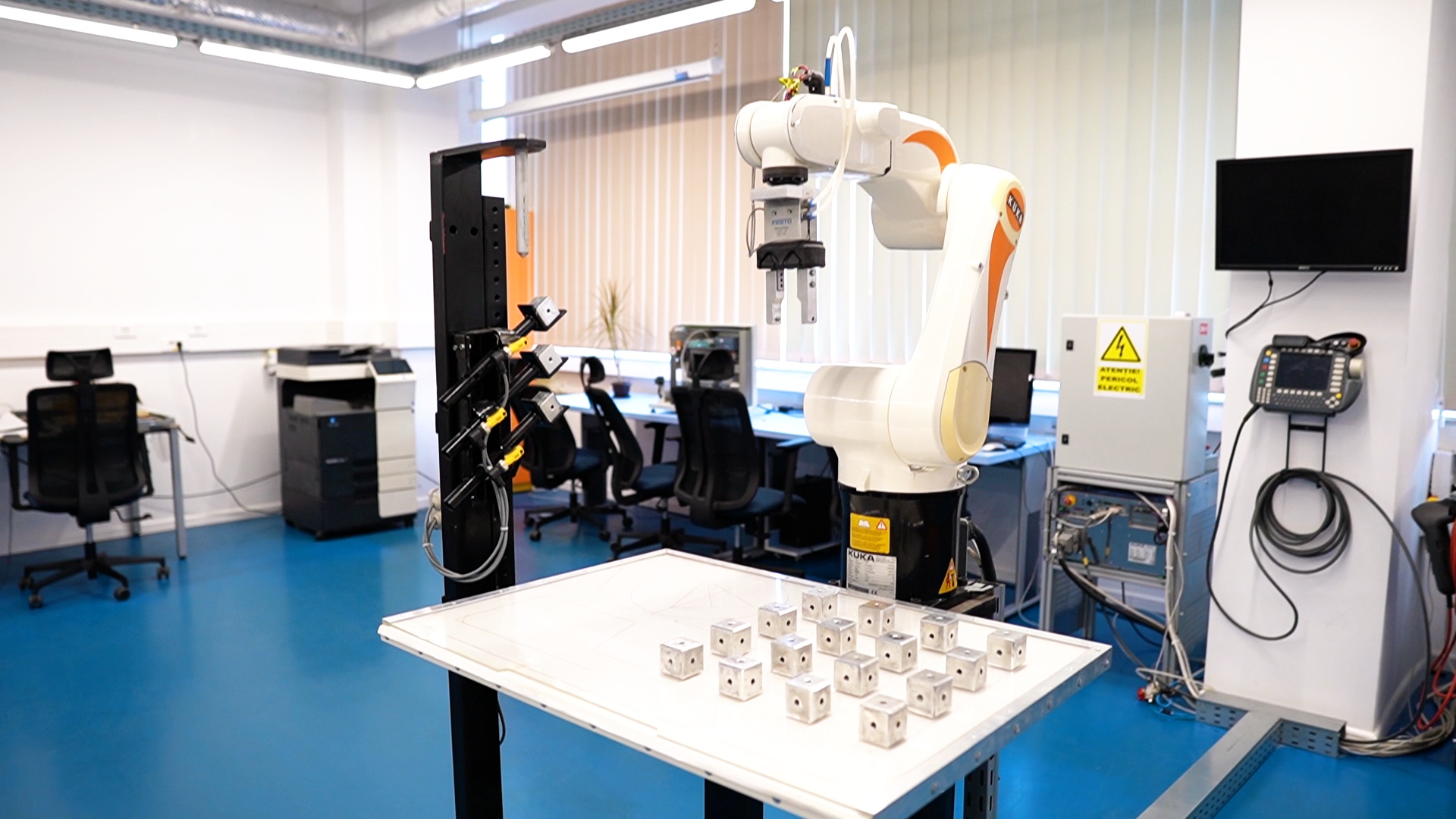
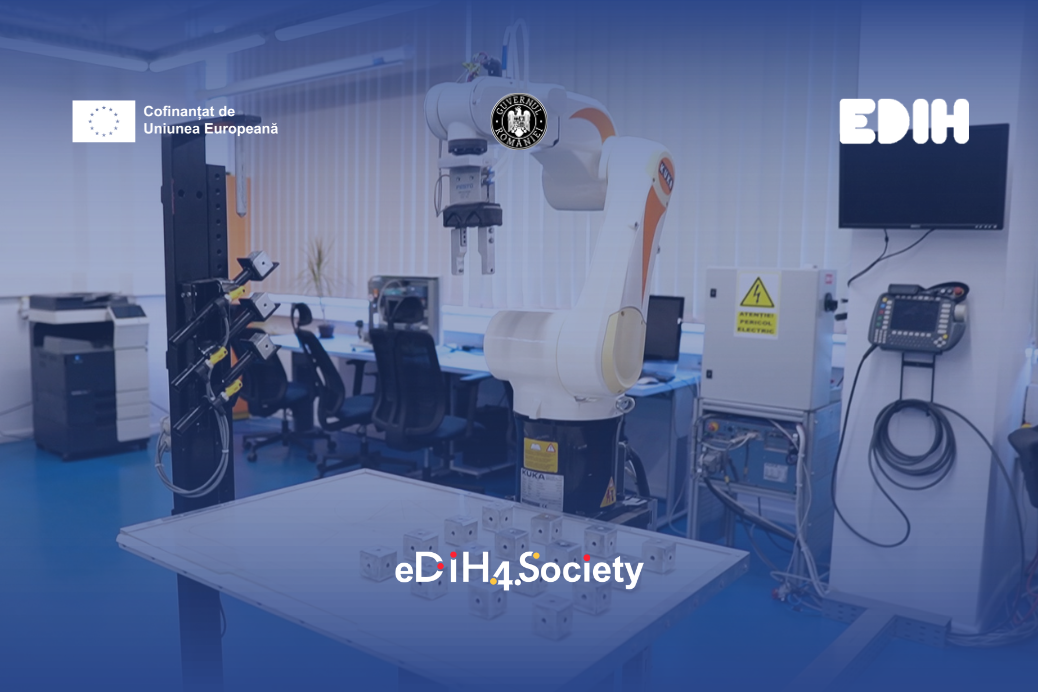
- KUKA KRC 2 SR Robotic Cell for Handling Applications – This workstation includes a KUKA robotic cell, which allows the development and testing of handling applications. Cloud communication is also possible, which allows experimentation with cloud automation and connectivity solutions.
- SMC MAS 201 Demonstration Station – This workstation offers the possibility to experiment with automated applications that use linear pneumatic actuators for handling body parts. It is an excellent opportunity to learn and become familiar with pneumatic technology in the context of Industry 4.0.
- SMC MAS 202 Demonstration Station – This station offers an environment in which automated applications can be developed and tested that use linear and oscillating pneumatic actuators, together with a pneumatic gripper for handling shaft-type parts.
- SMC MAS 203 Demonstration Station – The SMC MAS 203 station is specialised in automated applications that use linear pneumatic actuators and vacuum gripping systems for handling cover-type parts.
- SMC MAS 204 Demonstration Station – This station allows the development and testing of automated applications that use rotary pneumatic actuators and a gripper gripping system for handling bearing-type parts.
- SMC MAS 205 Demonstration Station – The SMC MAS 205 station is equipped for automated applications that use parallel tandem linear pneumatic actuators, guided cylinders and gripper gripping systems for transferring and handling parts.
- SMC Electropneumatic Demonstration Station – This station offers the possibility to experiment with automated applications that use linear electric actuators and vacuum gripping systems for transferring and handling parts to a fixed point.
- Pneumatic Automation Simulation Software Licence – AUTOSIM 200 – This software licence allows the design and testing of the operation of pneumatic and electrical schemes, the construction of control panels and the 3D model for automation applications. A valuable resource for learning and improving pneumatic automation skills.
- Automation Test Station with Vision System and RFID – The stand with identification technologies is equipped with two essential tools for modern industry – a barcode reader and a radio-frequency identification (RFID) device. This stand is ideal for technical training in areas such as reading and interpreting 1D and 2D codes, optical character recognition (OCR), object recognition, code quality verification, comparing reading results with a preset value and formatting data for subsequent use. The Siemens SIMATIC MV440 video camera is a versatile tool that can read a wide range of barcodes and matrices, regardless of the printing method or the transport medium used. With an operating range between 70 mm and 3,000 mm, it can be used in a variety of industrial scenarios. The RF250R RFID reader, on the other hand, is ideal for application in areas such as assembly and handling technology, production logistics and intralogistics, and transport technology. By attaching a transponder to products or pallets, it can be used for the quick and efficient identification of various objects within an industrial operation. Through this stand, students and industry professionals can gain hands-on experience with these essential technologies, understanding how they can be applied to improve the efficiency and accuracy of industrial processes.
Training services in using the Laboratory's facilities:
Professional training services
- Basic, intermediate and advanced Siemens PLC programming – From beginner to expert, this detailed training programme will give you the skills needed to programme, diagnose and repair Siemens PLCs. Including courses on the latest technologies and practices in the field, this training will prepare you for the requirements of the modern automation industry.
- Basic, intermediate and advanced ABB robot programming – This training programme will cover the essential aspects of ABB robot programming. From an introduction to the basic principles of robot programming to the development of advanced automation solutions, you will be guided step by step by qualified experts.
- Basic, intermediate and advanced Fanuc robot programming – Through this training programme, you will learn how to programme Fanuc robots for a variety of tasks in the industrial environment. From setting up and calibrating robots to creating complex programs, you will become competent in working with these sophisticated automation systems.
- Basic, intermediate and advanced Motoman Yaskawa robot programming – This course will guide you through all the aspects needed for the effective programming of Motoman Yaskawa robots. You will become familiar with the basic principles, as well as the advanced techniques that allow optimal and efficient use of these robots in different industrial situations.
- Basic, intermediate and advanced Kuka robot programming – This training programme will guide you through the entire process of programming Kuka robots, from an introduction to basic operation to the development of complex applications. You will acquire the techniques and skills needed to work efficiently with Kuka robots in a wide range of industrial applications.
- Python programming for industrial applications – Developed to provide a solid understanding of the Python programming language and its use in industrial applications, this course will cover aspects such as data structures, algorithms, objects, classes and the Python module for automation applications.
- Robotic systems design in RoboDK – This programme provides practical knowledge and skills for designing robotic systems using RoboDK. You will learn to simulate, programme and optimise robotic production processes.
- Artificial intelligence for industry – This course gives you an in-depth understanding of how artificial intelligence (AI) technologies can be applied in the industrial sector. Touching on topics such as machine learning, natural language processing, predictive analytics and neural networks, you will learn how to develop AI solutions that can optimise operations, improve efficiency and drive innovation in manufacturing.
- Development and use of digital replicas (Digital Twins) – Digital twins are an emerging technology with the potential to revolutionise manufacturing and asset management. This course will show you how to create and use digital twins to model, analyse and improve production systems. From creating digital models based on advanced mathematical formalisms to simulating and analysing performance with artificial intelligence, you will learn how to use this powerful technology to bring tangible benefits to your activity.
- Robotic systems design in Visual Components – The course on robotic systems design in Visual Components provides an introduction to creating advanced robotic scenarios. You will learn to configure and programme virtual robots, create efficient workflows and design fully functional robotic production systems, allowing you to analyse and optimise production processes before they are implemented in reality.
- Development of chatbots, autonomous virtual assistants – This course provides an introduction to the design and development of chatbots and autonomous virtual assistants. Learners will learn about the fundamental principles of natural language processing, conversational design and the creation of personalised interactive experiences, enabling them to create AI-based assistance solutions that can improve customer service and operational efficiency.
- ROS programming for mobile robots – The ROS programming course for mobile robots focuses on developing the skills needed to create and improve the performance of mobile robots. From learning the basics of ROS (Robot Operating System) to implementing algorithms for autonomy, this course will equip you with the skills needed to navigate the constantly evolving field of mobile robots.
- Social robot programming – In this course, you will learn how to programme social robots that can interact naturally and effectively with people. Covering topics such as emotion recognition, learning through interaction and the development of complex behaviours, the course will help you create robots that can enhance the human experience in a variety of social contexts.
- Design of robotic systems for non-industrial applications – Our course on the design of robotic systems for non-industrial applications focuses on developing the skills needed to design and implement innovative robotic solutions in fields such as healthcare, education and households. Learners will learn how to design, programme and integrate robots in a variety of real-life scenarios.
- Development of cloud robotic architectures for Industry 4.0 – You will be introduced to the key concepts of cloud technologies, as well as how they can be used to facilitate communication between robots and improve the operational efficiency of production processes. You will also learn about security protocols for protecting data and information in interconnected work environments.
- Proiectare si simulare sisteme automatizate utilizand actuatori pneumatici – This course provides an introduction to the use of pneumatic actuators in automated systems. You will learn how to design and simulate systems that use this technology to perform a variety of tasks, from delicate product handling to high-speed assembly operations. In addition, you will be introduced to concepts of safety, energy efficiency and noise reduction in pneumatic systems.
- PLC programming in Grafcet and Function Block diagrams for automation – This course will introduce you to PLC programming using Grafcet and Function Block diagrams. You will learn how to use these methodologies to programme automated control systems, learning key concepts such as Boolean logic, sequencing of operations and error handling. By applying this knowledge, you will be able to design and implement customised automation solutions for a variety of industrial applications.